
The problem RAG is built to solve
To see why retrieval-augmented generation matters, you have to be precise about what a plain language model does. A model like this generates fluent text by predicting likely continuations based on patterns learned during training. It is not consulting a database of facts; it is producing plausible-sounding language, and when the plausible language happens not to be true, the result is a confident fabrication — a hallucination. Crucially, the model has no built-in way to tell you where an answer came from, because it did not come from a specific source at all. It was generated.
For the information world, these two failings — unreliability and the absence of provenance — are precisely the ones that cannot be tolerated. A library's value lies in trustworthy, attributable knowledge; a research citation that points to a source that does not exist corrupts the whole chain of scholarship. So the question for anyone thinking seriously about AI in libraries is not whether conversational tools are impressive — they are — but whether they can be made accurate and, above all, sourced. Retrieval-augmented generation is the direct answer to that question: a way of keeping the fluent, conversational interface while anchoring what it says to real documents that can be checked.
How retrieval-augmented generation works
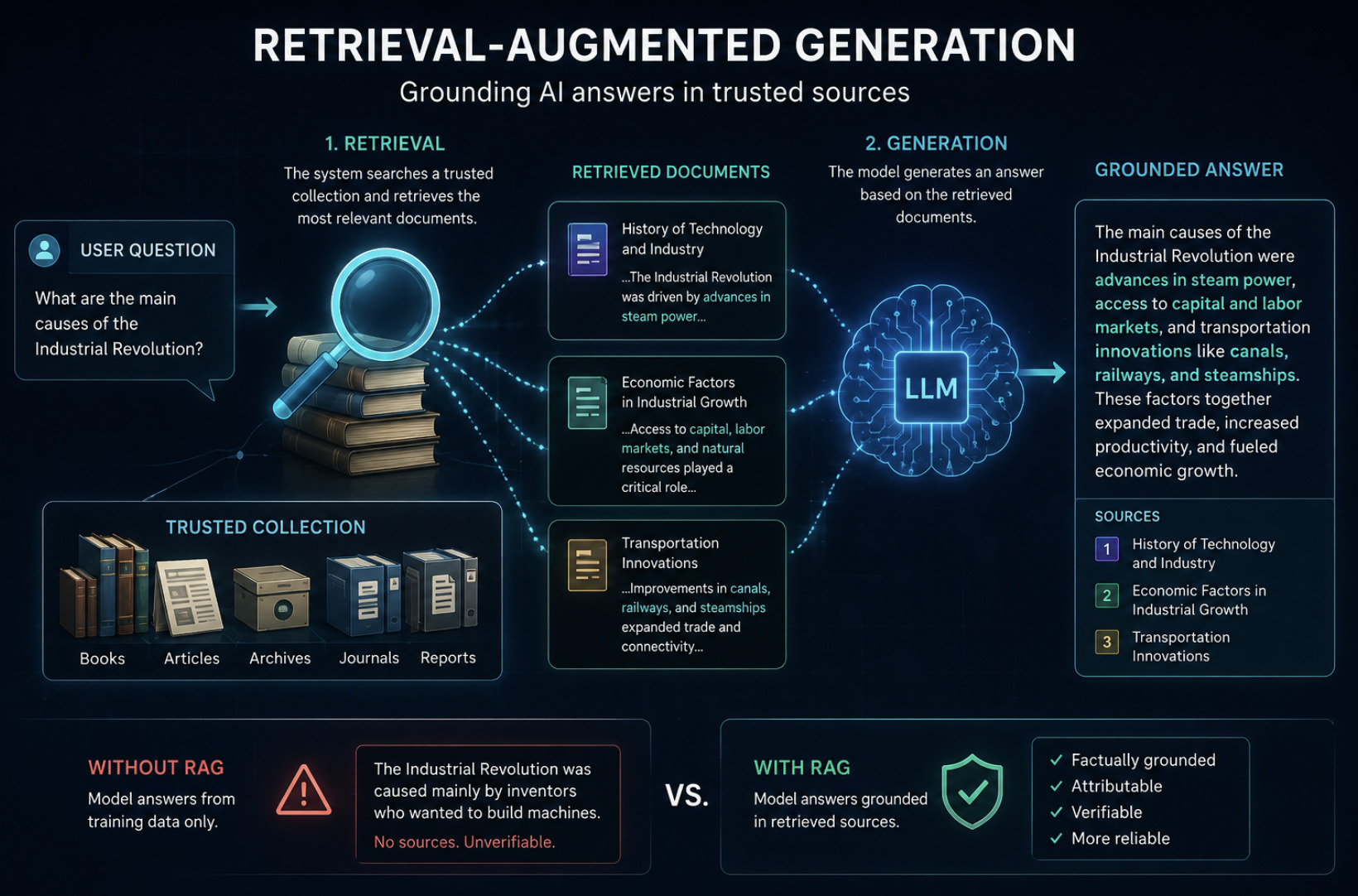
The idea is elegant, and once grasped it demystifies the whole thing. Instead of asking a language model to answer from its own training — its imperfect, unattributable memory — a retrieval-augmented system first retrieves relevant documents from a trusted collection, and then asks the model to generate its answer based on those retrieved documents. The model is no longer drawing the answer out of thin air; it is being handed the relevant source material and asked to compose a response grounded in it. Retrieval supplies the facts; generation supplies the fluent, readable answer.
This two-step structure changes everything about the tool's suitability for serious use. Because the answer is built from specific retrieved documents, the system can point back to exactly which sources it drew on — restoring the provenance that a plain model cannot provide. And because the model is working from real, trusted material rather than its own recollection, it is far less prone to fabrication; when it is grounded in an actual document, it has something true to work from rather than a gap to fill with invention. The fluent conversational experience is preserved, but it is now tethered to a verifiable foundation. That combination — natural-language access plus grounding and attribution — is exactly what the information professions need, and it is why this pattern has generated so much genuine interest rather than mere hype.
Why this fits libraries and archives so naturally
Retrieval-augmented generation is not just a general improvement to AI; it is peculiarly well-suited to what libraries and archives actually are and do. These institutions already possess exactly what such a system needs: large, curated, trusted collections of documents. The whole practice of librarianship is the organisation and stewardship of reliable information, which means a library is, in effect, sitting on the ideal retrieval source — a body of vetted material from which grounded answers can be drawn. Where a general AI tool must scrape the open web with all its noise and unreliability, a library-based system can retrieve from a collection whose quality is already assured.
This turns the technique from a generic capability into something that plays to the information professions' deepest strengths. A retrieval-augmented system built on a library's collection offers patrons conversational, natural-language access to that collection — ask a question in plain words, receive a grounded answer drawn from real holdings, with pointers to the sources — while preserving the accuracy and attribution that make the collection trustworthy in the first place. It is a way of making vast, well-curated holdings more accessible without sacrificing the reliability that is the whole point of curating them. The values of the field and the requirements of the technology align unusually well, which is rare and worth noticing. It also depends, of course, on the stable, identifiable sources that scholarship relies on, a foundation we examined in the persistent identifiers holding digital scholarship together.
The limits worth stating plainly
For all its promise, retrieval-augmented generation is not magic, and treating it as a complete solution would be a mistake the information professions in particular should avoid. The most important limit is that the technique is only as good as the material it retrieves. If the underlying collection is incomplete, biased, or contains errors, the system's grounded answers will faithfully reflect those flaws — grounding an answer in a source makes it attributable, not automatically correct. Retrieval improves reliability by tethering the model to real documents, but it inherits whatever is wrong with those documents, so the quality and curation of the collection matter enormously.
There is a subtler caution too. Even a well-grounded system can misread or misrepresent the documents it retrieves, summarising them inaccurately or drawing a conclusion the source does not support, so the presence of a citation is not a guarantee that the answer faithfully reflects it. This is precisely why the technique suits libraries: the professional habits of verification, source-checking and critical evaluation that the field already embodies are exactly what is needed to use these tools responsibly. Retrieval-augmented generation does not remove the need for human judgement; it makes that judgement possible by providing sources to check, and it works best in the hands of people trained to check them. The right posture is neither uncritical enthusiasm nor reflexive rejection, but the same evidence-minded scrutiny the field applies to any source.
A pattern the information world should understand
The reason retrieval-augmented generation deserves the attention of anyone who cares about libraries, archives and scholarship is that it represents a genuine path to using AI without abandoning the values that define these institutions. It keeps the transformative promise — conversational, natural-language access to knowledge — while restoring the two things a plain language model destroys: accuracy grounded in real sources, and the provenance that lets an answer be verified. For a field built on trustworthy, attributable information, that is not a minor technical detail; it is the difference between an AI tool that belongs in a library and one that actively undermines it.
This is why the pattern is worth understanding even for those who do not build systems. It reframes the question of AI in the information professions from "should we use these unreliable tools?" to "how do we ground them in our trusted collections and our verification practices?" — a far more productive question. The institutions that hold curated, reliable knowledge are unusually well positioned to deploy this technology on their own terms, making their collections more accessible while keeping them trustworthy. Retrieval-augmented generation is not the final word on AI in libraries, and its limits are real, but it is the clearest sign yet that the fluent power of language models and the exacting standards of scholarship need not be at odds. Getting that relationship right is one of the more important tasks facing the information world, and this pattern is where the work begins.
Frequently asked questions
What is retrieval-augmented generation? It is an AI approach where, instead of answering from its own training, a language model first retrieves relevant documents from a trusted collection and then generates its answer based on those documents. Retrieval supplies the facts and provenance; generation supplies the fluent, readable response, grounding the model in real, checkable sources.
Why does retrieval-augmented generation reduce AI hallucinations? Because the model works from actual retrieved documents rather than its own imperfect memory, so it has real material to base its answer on instead of a gap to fill with invention. It also lets the system point back to the specific sources it used, restoring the provenance a plain language model cannot provide.
Why is this technique well-suited to libraries and archives? Because these institutions already hold large, curated, trusted collections — exactly the reliable source material retrieval-augmented generation needs. A system built on a library's holdings can offer conversational access to the collection while preserving accuracy and attribution, aligning the technology with the field's core values of trustworthy, verifiable information.
What are the limits of retrieval-augmented generation? It is only as good as the collection it retrieves from — incomplete, biased or erroneous sources produce flawed grounded answers. And even a well-grounded system can misread or misrepresent a document, so a citation is not a guarantee of accuracy. It reduces but does not remove the need for human verification and critical judgement.