Bone, ivory, and the question of what counts as a die
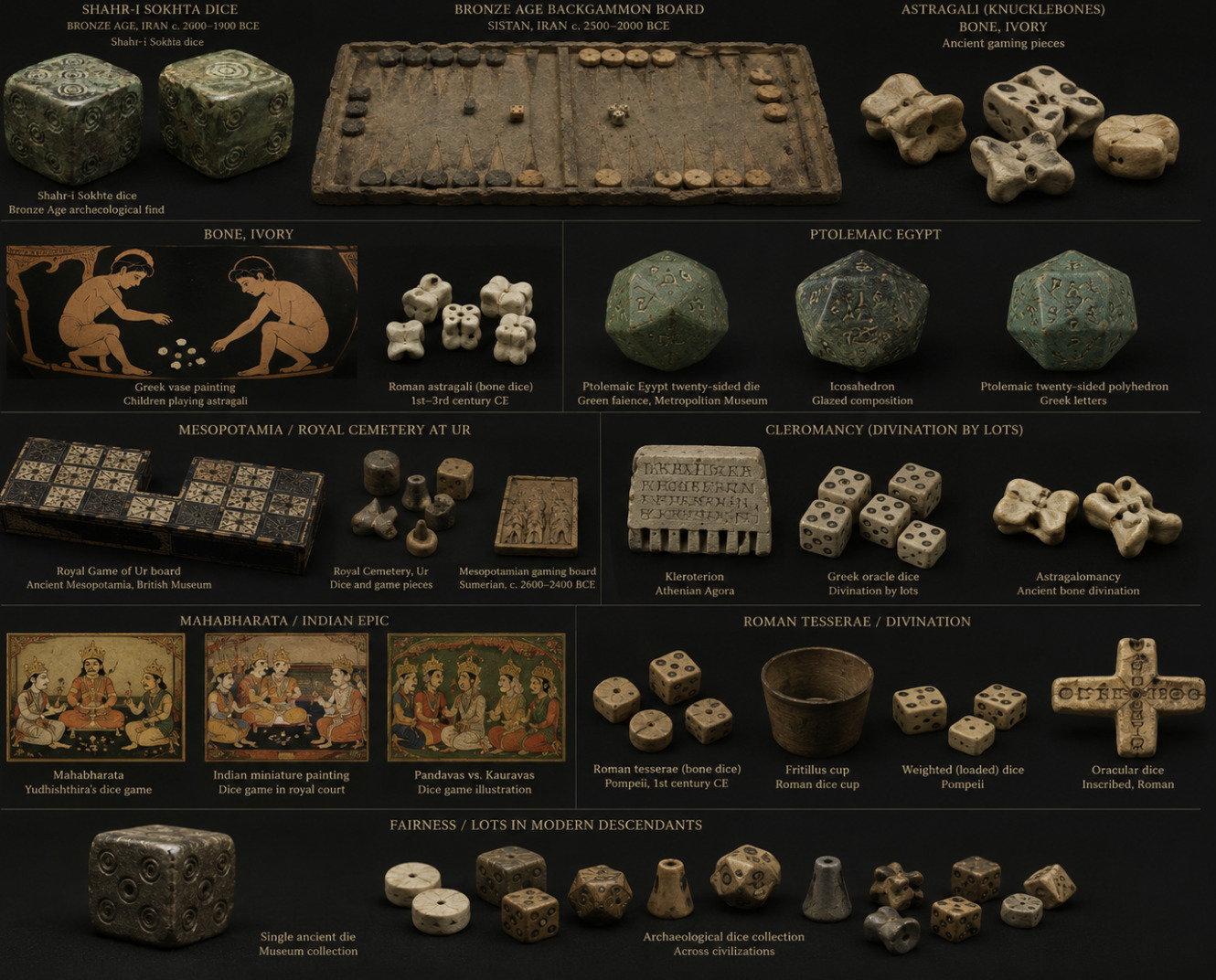
Earlier than the Shahr-i Sokhta finds are the astragali — the knucklebones of sheep and goats — used across the Near East and the Mediterranean for at least seven thousand years. An astragalus is naturally a four-sided object: when thrown, it lands on one of four asymmetric faces, each with a distinct probability the bone's anatomy roughly determines. They appear in Bronze Age sites from Anatolia to the Indus Valley, in Egyptian tombs, and on Greek vase paintings.
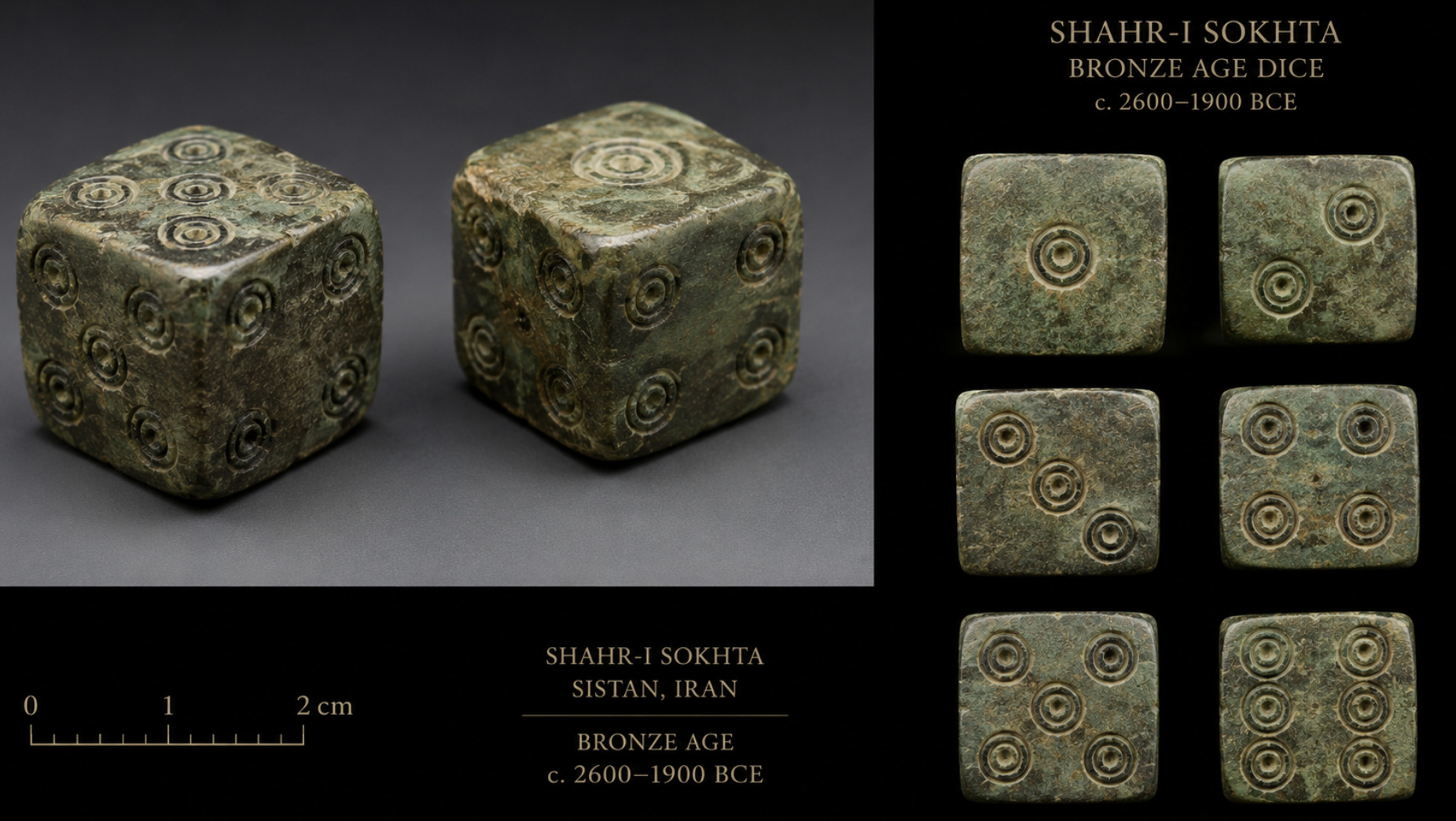
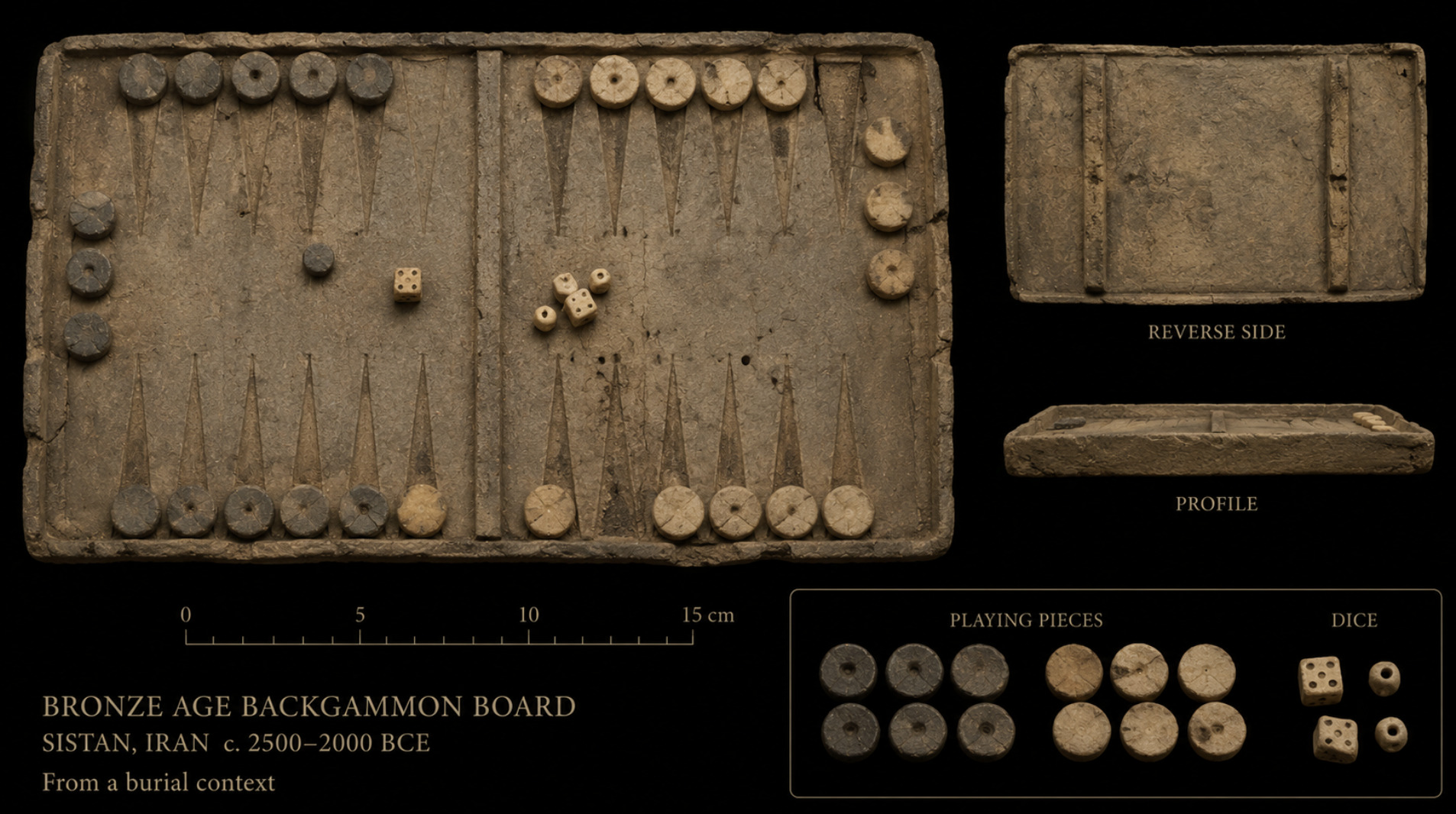
The decisive transition from astragalus to die is the moment a human being decides to shape a six-sided cube rather than rely on what an animal's ankle provided. By that gesture, randomness becomes something humans manufacture, not something they borrow from a goat. The earliest unambiguously dice-shaped objects so far recovered — including the Shahr-i Sokhta examples, and later finds from Mesopotamian sites such as the royal cemetery at Ur — are recognisably the same form any modern player would identify. Cubes, roughly twenty millimetres on a side, marked with dots whose values are sometimes arranged in the modern pattern (opposite faces summing to seven) and sometimes not.
The materials matter. Bone and ivory dominated the early period; stone and faience emerged with greater specialisation. The famous twenty-sided polyhedra of Ptolemaic Egypt — exquisite green-glazed objects, some bearing Greek letters — survive in museum collections and date from a culture mathematically advanced enough to take an interest in random objects with more than six outcomes.
Cleromancy and the religious work of randomness
What modern readers consistently underestimate is the religious freight that randomness carried in the ancient world. The Greek word kleros meant a lot, a portion assigned by chance; cleromancy was the practice of divining the gods' will by throwing lots, and it was not a folk superstition but a respected mechanism for serious decisions. The selection of certain civic officers at Athens used a randomising device — the kleroterion — that survives in fragmentary form. The Roman state cast lots to allocate provinces among magistrates. Oracles across the Mediterranean used dice and astragali to produce answers attributed to the gods.
The intellectual logic is worth dwelling on. A society that has not yet developed a mathematical theory of probability — and probability theory in its modern form does not begin until the seventeenth century, with Pascal, Fermat and the Port-Royal logicians — encounters randomness as something genuinely unaccountable. Outcomes the human mind could not predict were attributed to powers the human mind could not see. The thrown bone became a small ritual instrument by which the unseen was permitted to speak.
The Indian epic Mahabharata, composed across several centuries beginning roughly in the first millennium BCE, contains one of literature's most consequential dice games — the match in which the Pandava prince Yudhishthira loses his kingdom, his brothers, and the princess Draupadi to his cousin Duryodhana's loaded throws. Behind the literary surface is a culture in which dice were sufficiently central to royal ritual that a great epic could organise an entire moral catastrophe around them. The Vedic Rigveda's "Gambler's Hymn" carries the same texture — a first-person lament from a man ruined at dice that doubles as a meditation on how randomness exposes the speaker to forces larger than himself.
That association between chance and hidden order has never fully disappeared, even after probability theory stripped randomness of much of its supernatural explanation. Contemporary gambling culture still borrows, often unconsciously, from the older emotional structure of cleromancy: the sense that a throw, a spin, or a shuffled sequence can reveal something larger than pure arithmetic. Modern platforms understand this instinct extremely well. The visual language of digital gaming — glowing symbols, ceremonial animations, ritualised reveals, escalating anticipation — frequently reproduces the emotional architecture of ancient divination in a secular form. In spaces like Dicepalace Casino, randomness is no longer interpreted as the literal speech of gods, but it is still presented as an encounter with uncertainty that feels charged with meaning, suspense, and possibility beyond the merely mechanical.
Rome and the regularisation of the form
By the Roman imperial period, dice had become so common that the archaeological record is, on this question, almost overstuffed. Roman tesserae — six-sided dice of bone, ivory or stone — turn up at virtually every excavated military camp and civilian site across the empire, often paired with the cup-and-shaker apparatus (fritillus or pyrgus) used to prevent cheating. The Roman state's relationship with the practice was ambivalent: statutes such as the Lex Titia prohibited gambling at dice except during the Saturnalia festival in December, while the elite themselves played continuously regardless of the law. Augustus' surviving letters mention his own losses with the rueful tone of a man who knows he is not setting a good example.
Two artefacts from the period deserve mention. Weighted and asymmetric dice in the archaeological record — discovered at Pompeii and elsewhere — confirm that cheating was both an ancient art and an ancient anxiety. Cross-shaped tesserae with elaborate inscriptions on multiple faces survive too, used for fortune-telling rather than gambling: the combination of faces was indexed to a book of pre-written oracular responses. The line between game and divination, in the late ancient world, was thin and frequently crossed.
What the dice reveal
Step back from the catalogue, and the broader observation comes into focus. The simultaneous emergence of dice across multiple unrelated civilizations — Mesopotamian, Egyptian, Indus Valley, Aegean, later Chinese — is a clue not just about the history of gaming but about the architecture of urban societies. A society that produces dice has, at some level, developed two related capacities. It has begun to abstract chance as a category — to think about randomness as a thing rather than as the texture of an unpredictable world. And it has begun to value fairness as a procedural matter, because a die is, at its core, a device for producing outcomes that no human party controls.
The second capacity is the more profound. Ancient states cast lots for civic offices, religious roles, and the allocation of lands precisely because randomness gave them a way to produce decisions that could not be attributed to favouritism. The die was, in this light, an early instrument of impersonal procedure — a small piece of bone that allowed a community to step outside the politics of any single decision-maker. Modern fairness procedures, from jury selection to housing lotteries, are the institutional descendants of that gesture.
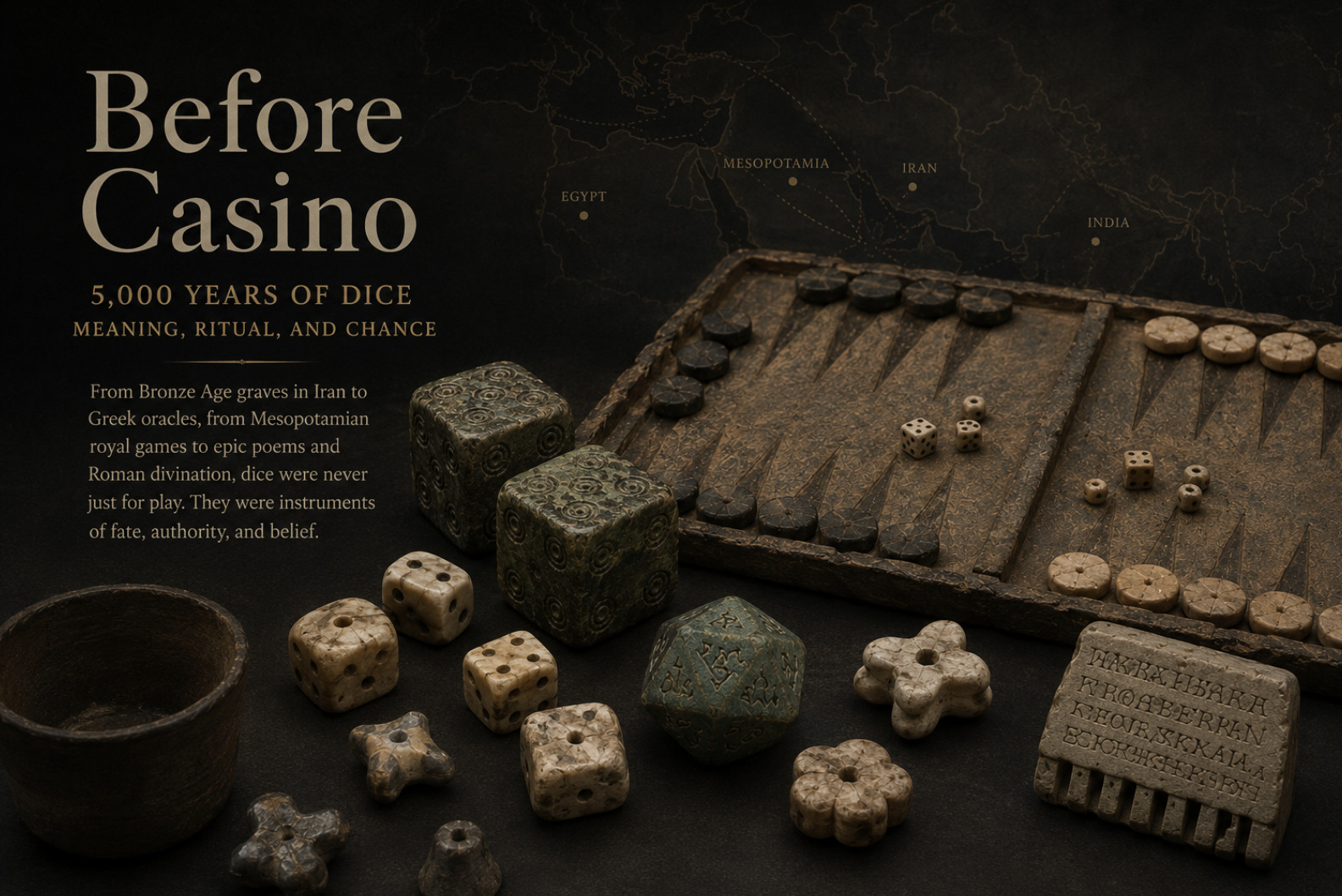
Five thousand years after the dice at Shahr-i Sokhta were placed in a Bronze Age grave, the objects themselves look almost identical to ones a modern player would recognise. What has changed is everything around them: the meanings the cultures attached, the rituals that contained them, and the mathematical apparatus that, over four centuries, turned chance from a face of the divine into a calculable quantity. The cubes have outlasted all of that — still, recognisably, what they were: small carved instruments by which human beings introduced something genuinely outside themselves into the rooms they were trying to organise.