
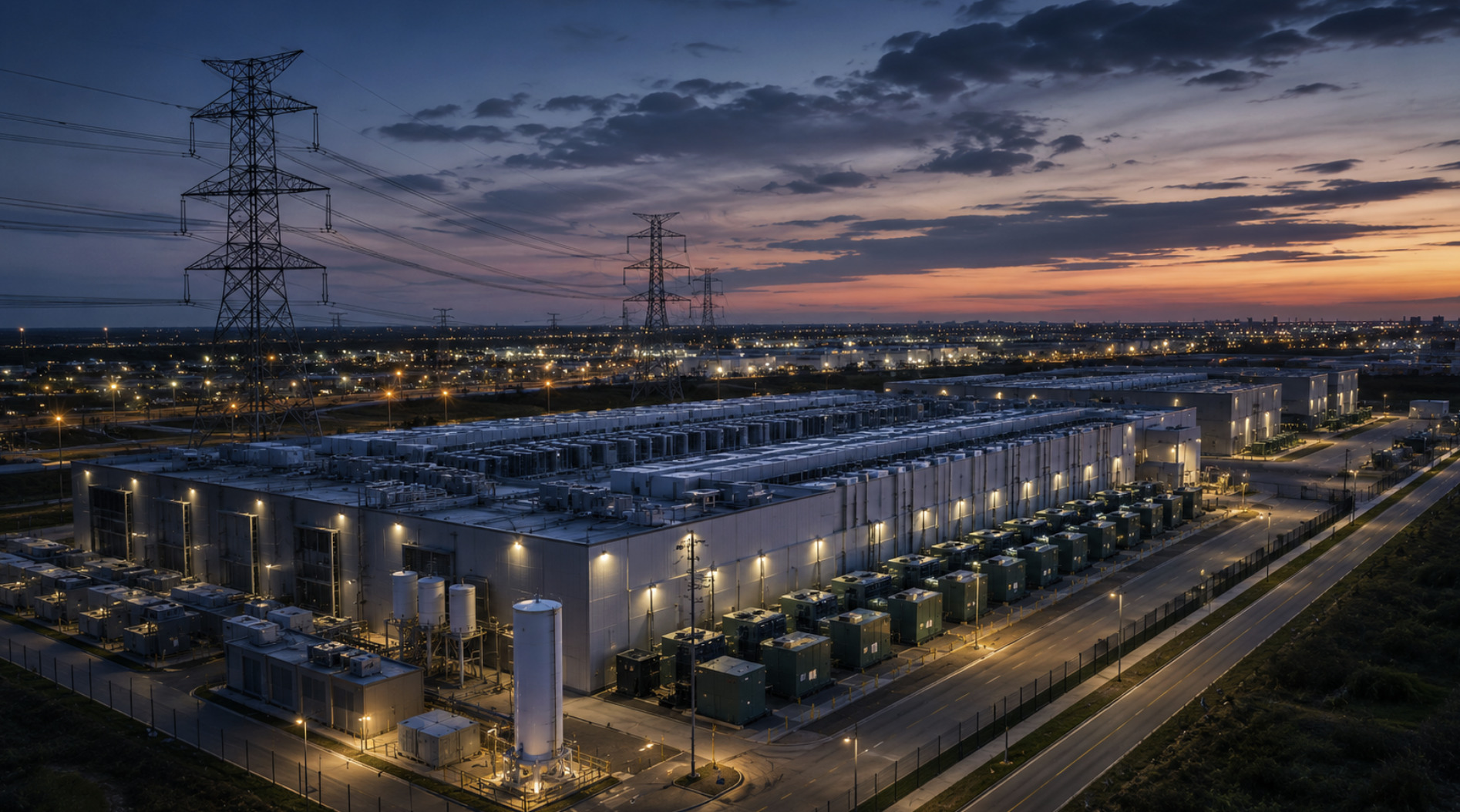
The physical reality behind the cloud
The word "cloud" was a marketing triumph and a conceptual disaster, because it made computing sound weightless. In reality, the cloud is a global network of data centers — enormous buildings filled with servers that must be powered around the clock and cooled constantly, because all that electricity turns into heat. A single large facility can consume as much electricity as a small city, and there are thousands of them, with more being built continuously to meet demand.
This physical reality has always existed, but it was easy to ignore while data center growth was steady and incremental. The energy was significant but manageable, absorbed by grids without much strain. What has changed is the trajectory. A new and voracious source of demand has arrived, and it is growing far faster than the gradual expansion the industry was accustomed to. The comfortable assumption that data center energy use would keep rising slowly, in step with efficiency gains, has collapsed. The building behind the cloud is drawing power at a rate that is now impossible to overlook.
Why artificial intelligence changed everything
The force reshaping data center energy demand is artificial intelligence, and understanding why requires appreciating how much more power AI consumes than the computing that preceded it. Training and running large AI models requires specialised, power-hungry hardware operating at intensities far beyond typical server workloads. An AI query can consume many times the energy of a conventional web search, and training a large model consumes an amount of electricity that would have been unimaginable for a single computing task a decade ago.
Multiply this by the explosive, industry-wide rush to build and deploy AI, and the effect on demand is dramatic. Every major technology company is racing to expand its AI capacity, which means building more data centers packed with more of the most energy-intensive hardware available, running as close to continuously as possible. The result is a surge in electricity demand that has broken the gentle upward curve of previous years and replaced it with something far steeper. AI did not merely add to data center energy use; it changed its rate of growth, turning a manageable trend into a pressing problem in a remarkably short time.
The strain on the grid
Electricity grids were not built for demand that rises this fast in concentrated locations, and that mismatch is where the strain shows. A data center represents an enormous, constant electrical load appearing in one place, and when many are built in the same region — drawn by land, connectivity, or favourable conditions — they can collectively demand more power than the local grid was designed to supply. Utilities and grid operators, accustomed to planning for gradual change, find themselves facing requests for connection at a scale and speed that outpaces their ability to build capacity.
The consequences are becoming visible. In some regions, the surge in data center demand is delaying connections, straining infrastructure, and complicating the balance between supply and demand that keeps a grid stable. It also collides with other pressures on electricity systems, including the broader electrification of transport and heating, all competing for the same finite capacity. Building new power generation and transmission takes years, while data centers can be built far faster, so demand is outrunning the grid's ability to keep pace. This is not a distant hypothetical; it is a live constraint now shaping where and whether new facilities can be built.
The environmental reckoning
Beyond the engineering challenge lies an environmental one that the industry can no longer sidestep. Electricity has to come from somewhere, and where it comes from determines the climate impact of all this computation. If the surging demand is met by fossil fuels, the emissions associated with AI and cloud computing rise accordingly, at exactly the moment the world is trying to reduce them. The clean-energy transition and the AI boom are, in this sense, competing for the same limited supply of low-carbon electricity.
This has forced a reckoning that was easy to defer while the numbers were small. Technology companies that positioned themselves as climate-conscious now face demand growth that threatens their own emissions targets, and the tension between AI ambitions and environmental commitments has become difficult to reconcile. There is also the matter of water, since many cooling systems consume significant quantities, adding another resource constraint in regions already under stress. The environmental cost of computation, long treated as an abstraction, has become concrete, measurable, and large enough that it can no longer be treated as an afterthought to the industry's growth.
The responses taking shape
Faced with these constraints, the industry and energy sector are responding on several fronts, though none is a complete solution. On efficiency, there is intense effort to make data centers and AI hardware do more per unit of energy, since even modest gains matter enormously at this scale. On supply, technology companies are investing directly in electricity generation, particularly low-carbon sources, to secure the power their expansion requires without simply adding to grid strain or emissions — some are pursuing dedicated arrangements to power facilities from specific clean sources.
There is also a growing recognition that demand itself must be part of the conversation, not just supply. Questions about where data centers should be built, how their load can be managed to support rather than destabilise grids, and whether the relentless expansion is entirely necessary are beginning to be asked seriously. None of these responses fully resolves the underlying tension between exploding demand and finite, ideally clean, supply. But together they mark the end of an era in which data center energy use was treated as an externality to be ignored, and the beginning of one in which it is a central constraint on how the digital economy grows.
Conclusion
The data centers behind the cloud have moved from the background of the energy conversation to its center, and artificial intelligence is the reason. AI's extraordinary power demands, multiplied across an industry-wide race to build capacity, have transformed a slow, manageable rise in data center electricity use into a steep surge that is straining grids, delaying connections, and colliding with climate goals and water constraints alike. The comforting abstraction of weightless computing has given way to a physical reality with a heavy and rising footprint. Efficiency gains, direct investment in clean generation, and harder questions about demand are all part of the response, but none dissolves the fundamental tension between how fast computation is growing and how slowly clean power can be built. The cloud was never weightless. Its weight is now pressing on the grid, and reckoning with it honestly is one of the defining infrastructure challenges of the age.